
Journal
When Colour Fades, Value Follows
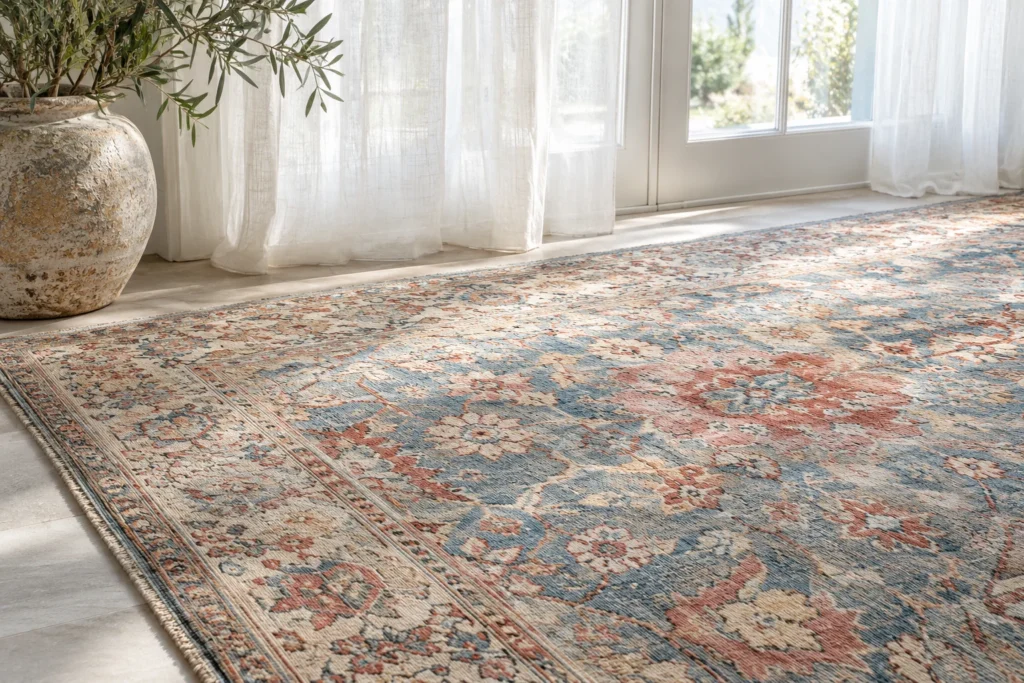
Colour is one of the reasons a fine rug can hold a room together. Deep reds, quiet blues and subtle variations within a field may give a woven work its particular character. When those relationships change, the design can become harder to read. Yet not every colour difference is damage, and not every faded area ought to be recoloured.
First, it helps to understand what has happened. Dirt can obscure a colour without changing the dye itself. Pile direction alters the way light reflects from the surface. Natural variations in yarn and dyeing, often described as abrash, may be integral to the rug's making. Actual fading is different: the colourant has changed through exposure, often unevenly where sunlight reaches one part of a room more than another.
The Canadian Conservation Institute explains that light damage to textiles accumulates and is irreversible. Both daylight and artificial lighting can contribute, with ultraviolet radiation presenting particular risks. Cleaning can remove appropriate soil, but it cannot restore a pigment or dye molecule that exposure has already changed. Any promise to 'bring back the original colours' should therefore be examined closely.
Consider a hypothetical antique rug whose window-facing half has paled while the area beneath furniture remains rich in colour. A dramatic before-and-after treatment might appear attractive online. For the owner, however, the essential questions are whether the fading is stable, whether any proposed recolouring would obscure historic material, and whether the change would be acceptable to future collectors. A brighter appearance is not automatically a more authentic one.
Recolouring can involve adding new material to an old textile. It may be justified in carefully defined circumstances, but it must not be confused with reversing age. Materials selected for compatibility, including dyes described as natural or environmentally considerate, still require informed assessment. A treatment's virtue depends on its effect on the particular fibres and original colours.
Where colour has moved during washing, the issue is different again. Dye bleeding may result from moisture interacting with unstable colourants. The Canadian Conservation Institute advises colourfastness testing before considering wet cleaning for museum textiles, while stressing that testing cannot remove every risk. Attempting to correct bleeding without understanding the chemistry may make the damage harder to address.
The strongest defence is preventive. Draw curtains during periods of direct sunlight, rotate the rug when appropriate, avoid prolonged exposure near heat sources and retain photographs that show its appearance over time. A comparison of dated images may reveal gradual changes an owner would otherwise miss.
Photographs should be taken in consistent natural light and kept unedited when used as a condition record. A sequence of images can be far more informative than memory, especially when a change has occurred slowly over several seasons.
Financial value is influenced by the textile's overall merit, not colour in isolation. Some wear is accepted in rare historic works; intervention can carry costs of its own. Oriental Rug Services Ltd recommends examining colour change before choosing any treatment, so that a wish for visual improvement does not compromise what makes the piece important.
Sources and further reading
Canadian Conservation Institute, Preventive Conservation Guidelines for Textiles