
Journal
The Ego and the Investment: Why Owners Take Pride in Their Rugs
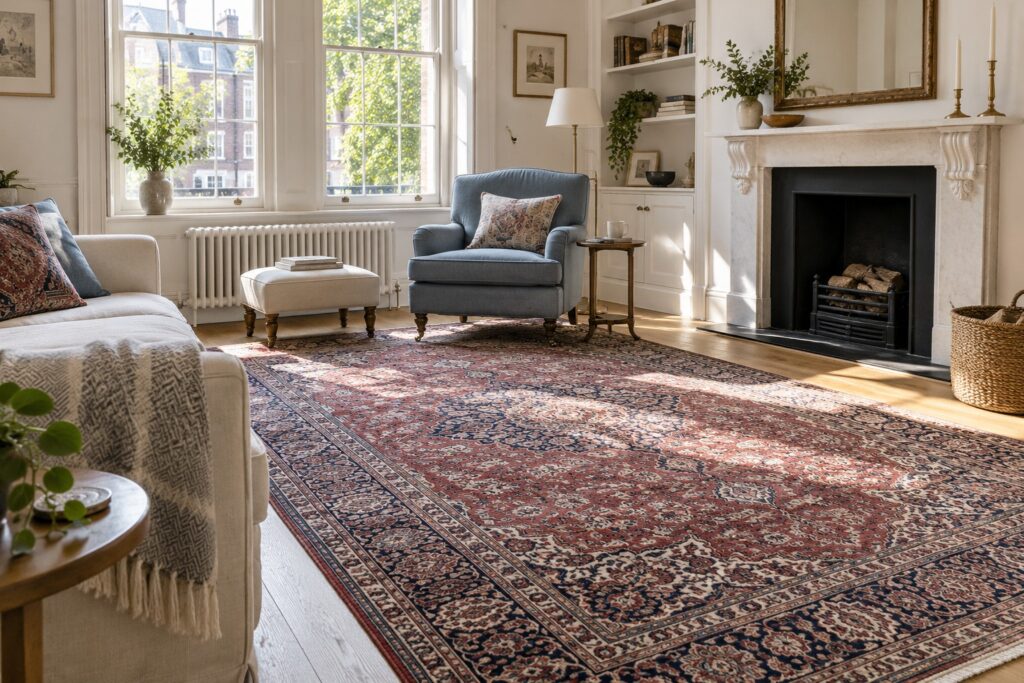
A beautiful rug rarely announces itself in the way a new acquisition might. It settles into the architecture of a room and gradually becomes part of the family's visual memory. Its colours are noticed in morning light, its pattern frames furniture, and its texture gives an interior a feeling that no catalogue description can adequately capture.
For some owners, the attraction begins with design. For others, it is the knowledge that an accomplished weaver made the piece by hand, knot after knot, long before the current household existed. That awareness changes the relationship. The rug is no longer simply something chosen for a room; the room becomes a setting for the rug.
There is nothing improper about pride of ownership. Collecting has always involved taste, curiosity and an appreciation of rarity. The question is what happens when pride begins to influence care. An owner who wants an antique to look immaculate may inadvertently ask for precisely the treatment that diminishes its character. A slightly irregular edge, gentle abrash or an aged surface may be evidence of a textile's making and history rather than a fault to erase.
The Metropolitan Museum of Art describes how carpets in the Safavid period were associated with royal workshops, diplomatic gifts and elite interiors. That history helps explain why rugs can carry status across centuries. Yet status is not the same as quality, and neither is a guarantee of financial appreciation. A genuinely distinguished work deserves appreciation on its own terms.
When discussing restoration, the most valuable question is often not 'Can you make it perfect?' but 'What should remain untouched?' A conservation-minded specialist can distinguish stable wear from progressive loss, identify vulnerable edges and discuss whether a proposed repair is sympathetic to the original weave. Good work should support the rug's continued life, not rewrite its past for a more dramatic photograph.
Ownership also carries a practical responsibility. Strong sunlight, furniture pressure, unnecessary wet cleaning and prolonged storage in unsuitable conditions can slowly change a piece. None of these problems is especially glamorous. Their prevention, however, is one of the clearest expressions of respect for the object.
A collector in Mayfair may display a rug in a formal reception room; a family in Hampstead may have lived with theirs for generations. Both can value their pieces for different reasons. What unites discerning ownership is not the postcode or purchase price but the willingness to learn about the textile and make decisions that honour it.
The most satisfying ownership stories are rarely about what a rug cost. They are about how it was discovered, how its pattern came to be understood, and why it still belongs in the room. Those stories become more convincing when supported by informed care and careful records.
At Oriental Rug Services Ltd, the objective is to preserve authenticity, craftsmanship and longevity. Where restoration is appropriate, careful examination helps determine how much intervention is enough. Pride is best sustained when the work remains recognisably itself, with its history still present.