
Journal
When Is a Rug Beyond Saving?
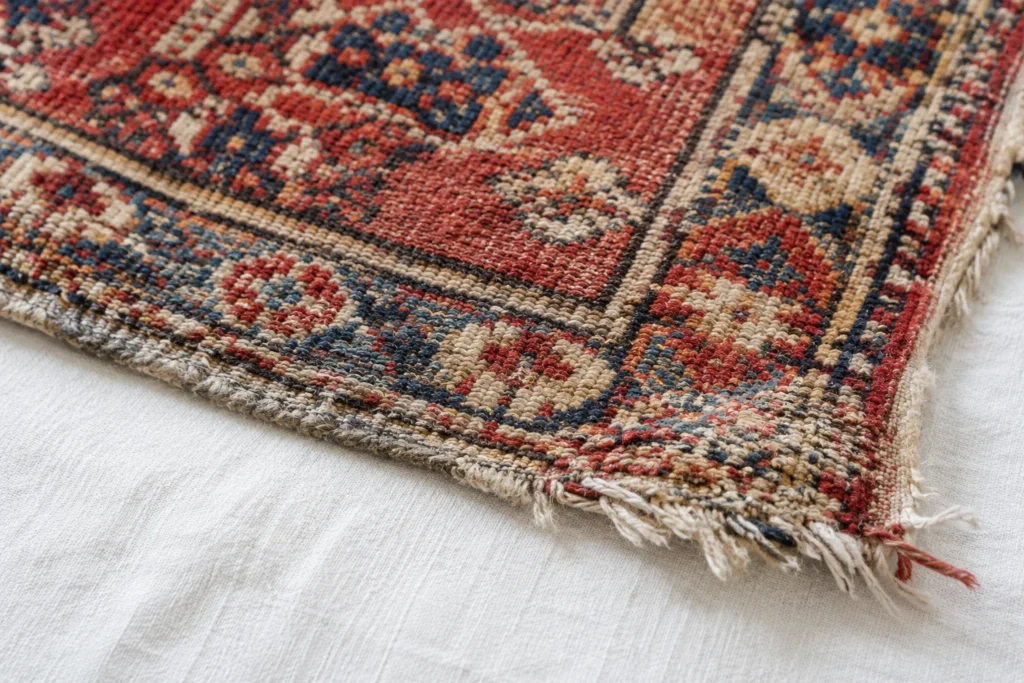
A damaged antique rug can look far worse than it is. A weakened edge, missing corner or area of lost pile may suggest that its useful life has ended, particularly when the owner has no experience of textile restoration. Yet appearance alone is a poor basis for a decision. Some pieces can be stabilised or repaired with considerable skill; others may be so fragile that intervention would create more loss than benefit.
Before asking whether a rug can be restored, it is worth asking what restoration should achieve. Is the piece intended to return to regular use, to be displayed with limited handling, or to be preserved as a family or historic object? The answer affects what an appropriate treatment might look like. A rug does not have to regain a completely even surface to remain meaningful or valuable.
Structural examination is essential. The foundation may have weakened beneath apparently sound pile. Damage may extend beyond a visible tear, while a small localised loss may prove relatively straightforward to support. Insect activity, moisture, old adhesives and previous repairs can all change the risks. A decision made from a single photograph is therefore provisional.
There is also an important distinction between conservation and reconstruction. Conservation seeks to stabilise and retain surviving original material. Reconstruction may involve recreating missing areas of weave or design. Neither is automatically right or wrong, but the extent of new work should be discussed and recorded. The Canadian Conservation Institute's textile guidance emphasises the vulnerability of historic fibres and the importance of careful handling, supports and preventive measures.
Christie’s offers another useful perspective: rarity and artistic quality may sometimes outweigh visible wear, particularly in early carpets, while excessive or poor-quality restoration can undermine value. This is why an ambitious repair is not necessarily the best commercial decision. It may be entirely reasonable to stabilise an important fragment rather than attempt to make it resemble a complete modern furnishing.
Imagine an inherited rug with a large worn section and fraying ends. One proposal might be extensive reweaving. Another might involve protecting the vulnerable structure, limiting its use and retaining its remaining historic fabric. Without examination, neither course should be called correct. What matters is that the owner understands the trade-offs and the treatment respects the identity of the work.
The cost of intervention is also relevant. Some restorations require substantial skilled labour and may not be justified by resale value alone. A family may nevertheless choose to preserve a piece for emotional or cultural reasons. That is a legitimate decision when made with clear information.
Before discarding a rug, photograph both sides, avoid further strain and obtain a specialist opinion. Equally, before authorising a major restoration, ask what will remain original, what will be added and how the work will be documented.
Oriental Rug Services Ltd examines damaged pieces with preservation as the first consideration. An honest assessment should also explain when restoration is inadvisable. Sometimes careful repair is appropriate; sometimes restraint is the wiser form of expertise.
Sources and further reading
Christie’s, Collecting Guide: Oriental Rugs and Carpets
Canadian Conservation Institute, Preventive Conservation Guidelines for Textiles