
Journal
From Kensington to Hampstead: London’s Most Discerning Rug Owners
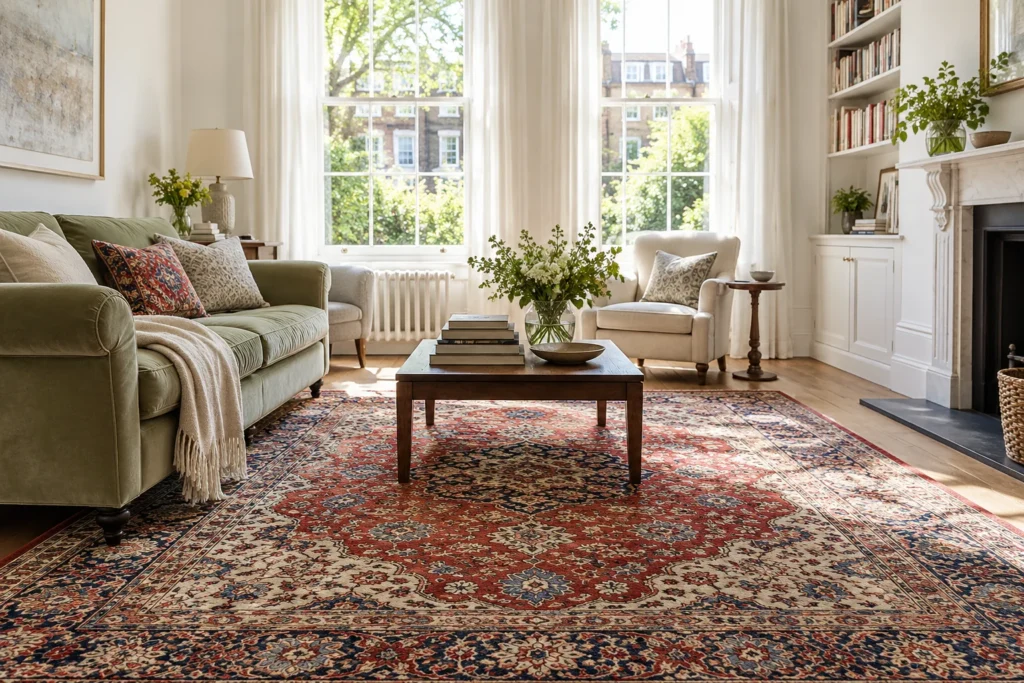
London's historic interiors reveal many different relationships with antique rugs. In a Kensington drawing room, a large Persian work may establish the proportions and character of the space. In a Hampstead home, a smaller tribal piece may be remembered less for its market value than for the family member who chose it. Both deserve attention, although their needs may be entirely different.
There is a misconception that ownership of a fine rug requires the object to be kept out of everyday use. Some pieces are too fragile for a busy floor; others can remain part of domestic life if their condition is understood and sensible precautions are taken. The more useful question is not whether a rug belongs in a prestigious property, but how its environment and use affect its future.
Light is an obvious example. Large windows are an architectural pleasure, yet sustained sunlight can fade dyes and weaken fibres. Furniture can compress pile or create localised stress. Dust and grit worked into the foundation can contribute to abrasion. The Canadian Conservation Institute recommends attention to light, careful handling, suitable underlay and periodic rotation where appropriate. These are principles of stewardship, not instructions to turn a home into a gallery.
The collection and return of a valuable rug also require more thought than arranging transport. Its condition should be recorded before it leaves the property, including pre-existing weak areas, staining, repairs and loose ends. Handling methods need to reflect its scale and construction. An old silk work, for instance, should not be treated as though it were a robust modern wool rug.
Discretion matters. Owners may have inherited pieces whose value they have never investigated, or important works acquired privately. A professional service should treat ownership history and the household itself with respect. The purpose of an assessment is to understand the textile, not to make assumptions about the client.
In St John's Wood or Chelsea, as elsewhere in the capital, the practical pressures of city life make clarity valuable. Owners benefit from knowing what has been observed, which treatment is proposed, why it is appropriate and how the piece will be handled and returned. Specialist expertise is most credible when it makes decisions intelligible.
Not every mark calls for intervention. Not every worn fringe should be replaced. In some cases, preventive adjustment in the home will do more good than a substantial restoration. Where intervention is justified, a record of what was done can become part of the rug's continuing provenance.
An owner's first consultation can be useful even when no treatment follows. It may identify a vulnerable area, a better position in the room or a storage practice worth changing. Sound advice should be valuable independently of an immediate commission.
Oriental Rug Services Ltd provides specialist collection, examination, care and return for important pieces in London homes. Our work begins with the rug rather than the postcode. For an owner considering a change of setting, professional treatment or long-term storage, an informed conversation can establish what the textile needs and what should be left alone.
Sources and further reading
Canadian Conservation Institute, Basic Care: Carpets and Rugs
Smithsonian Institution, How Do I Store Antique Textiles at Home?