Journal
How to Pass a Rug Down as a True Heirloom
An inherited rug often arrives with more questions than paperwork. Someone remembers it in a grandparent's dining room; another recalls that it came from abroad; a third believes it was once valuable. Its history may be partly true, partly forgotten and still worth preserving. The most useful gift to the next generation is therefore not simply the rug, but a reliable account of what it is and how it should be cared for.
Start with identification. Photograph the whole piece from both sides and record its dimensions, visible markings, distinctive repairs and any family knowledge of its acquisition. Keep invoices, older photographs, valuations and correspondence together. Label uncertainty honestly. 'Believed to have been bought in Tehran in the 1960s' is more useful than an unsupported declaration of age or origin.
Next, establish condition. Inspect edges, ends, pile and underside in good light, without pulling at weak threads. Look for signs of insects, unusual dust, brittle areas or changes in colour. If the rug has not been examined for years, a specialist can advise whether it needs treatment or simply better preventive care. A written record of findings gives future owners a starting point.
There is no single cleaning cycle appropriate for every antique rug. A robust work used daily will have different needs from a fragile silk piece displayed occasionally. The condition, construction and environment should determine inspection and treatment intervals. Regular observation is more valuable than following an arbitrary calendar.
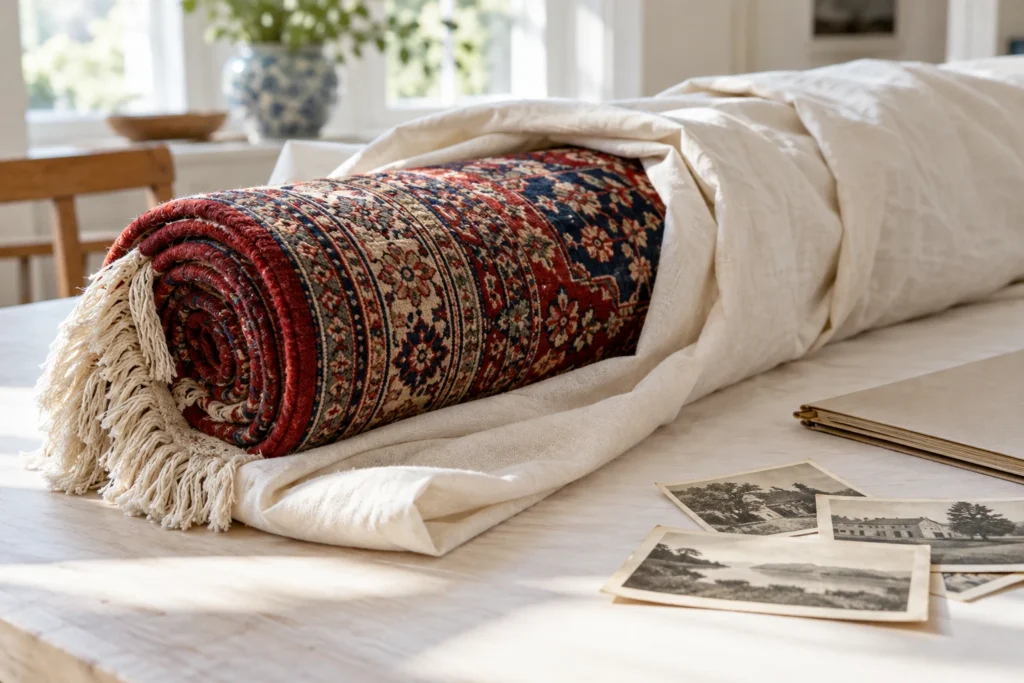
Storage can be decisive when a rug is passing between households. The Smithsonian advises keeping antique textiles in a clean, cool, dry and dark place with minimal fluctuations in temperature and humidity, rather than an attic or basement. The Canadian Conservation Institute recommends rolled storage for many rugs, using appropriate supports and protective materials instead of sharp folds. A piece should be clean and thoroughly dry before storage, with professional advice sought for particularly fragile examples.
A rug intended for continued use also deserves consideration in its new setting. Direct sunlight can fade colours; unsuitable underlay and heavy furniture can increase stress; damp floors may create preventable problems. A short written care note can help a recipient avoid errors made with good intentions.
If the piece may have significant financial value, consider a properly documented professional appraisal and discuss the appropriate insurance basis. Estate administration, division between beneficiaries and eventual sale may each require a different form of valuation. Avoid promising family members that every antique rug is an investment: its cultural and emotional importance may be greater than its resale price.
Finally, record any conservation or restoration. What was done, by whom, and why? Future owners should not have to guess which sections are original or how the piece was treated.
Oriental Rug Services Ltd helps families understand inherited pieces before decisions about cleaning, restoration or storage are made. A good handover also identifies who holds the records and where they can be found. A rug becomes a true heirloom when its history is handed on alongside the textile itself.
Sources and further reading
Smithsonian Institution, How Do I Store Antique Textiles at Home?
Canadian Conservation Institute, Basic Care: Carpets and Rugs