Journal
The Hidden Dangers of DIY Rug Cleaning
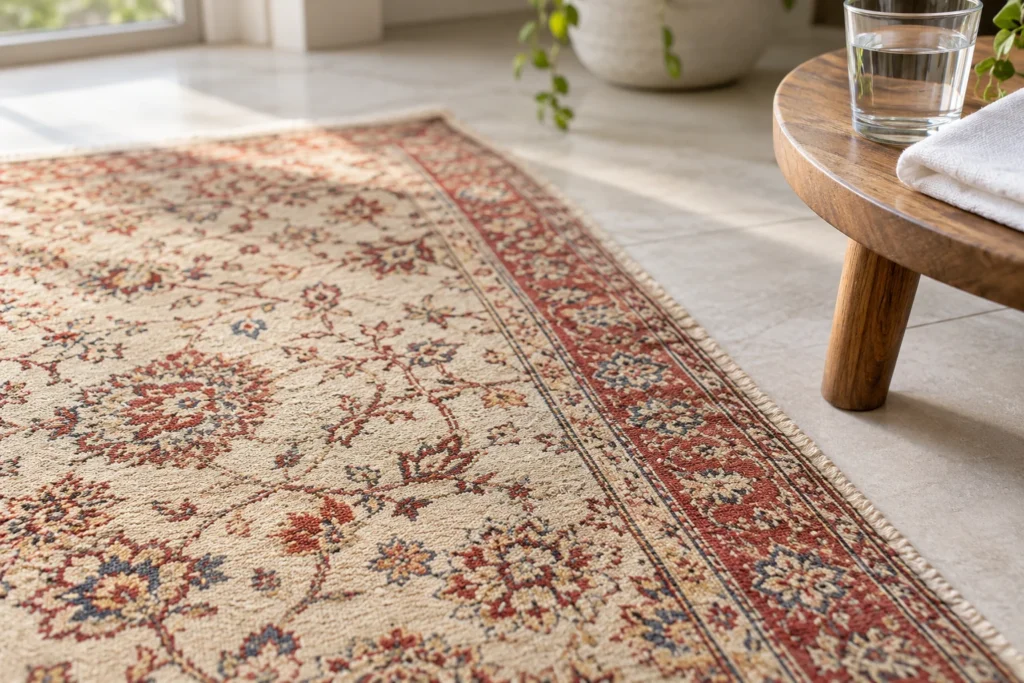
Most damage to a valuable rug does not begin with recklessness. It begins with a reasonable wish to remove a mark before it sets. A drink is spilt, a household product promises a quick solution, and the owner assumes that a woven rug will behave like any other furnishing. With an antique piece, that assumption may be the most expensive part of the accident.
The visible pile is only one element of a rug. Beneath it lie warp and weft threads, fibres of different ages and strengths, and dyes whose behaviour in water may be uncertain. The colours may have remained stable through ordinary use for decades without ever being tested against a modern detergent. Water, heat, alkalinity and friction can each change the result.
Imagine two possible responses to the same spill on a handwoven Persian piece. In the first, its owner scrubs vigorously with a supermarket spot remover. The mark lightens, but red dye migrates into a pale border and the fibres become distorted. In the second, the owner stops, absorbs surface moisture without rubbing and asks a specialist to examine the textile before further treatment. These are illustrations of risk, not accounts of actual ORS clients. The lesson is that speed and apparent cleanliness do not necessarily equal preservation.
The Canadian Conservation Institute's guidance on historic textiles is particularly instructive. It explains that wet cleaning is an irreversible intervention and that professional colourfastness testing should precede any proposal to wash a museum textile. Even a satisfactory test does not eliminate risk. Some fragile objects should not be wet-cleaned at all. Such guidance does not mean that every domestic antique requires museum storage, but it does reveal why treatment must be chosen for the individual object.
The sensible immediate response to a fresh spill is restrained. Prevent further contact, gently blot free liquid with a clean absorbent material where safe, avoid spreading it, photograph the area and seek advice promptly. Do not experiment with bleach, stain-removal sprays, steam equipment or homemade mixtures. If colours begin to transfer, further moisture may compound the problem.
Specialist cleaning is not simply a gentler version of household washing. It begins with identifying fibre, construction, prior repairs, soil and dye stability. The treatment may involve carefully controlled methods, or a decision to postpone washing until a structural concern is resolved. Sometimes the safest intervention is less intervention.
Claims of an 'eco-friendly' process should also invite a question: which products are appropriate for this particular rug, and why? A naturally derived substance can still affect dyes or fibres. Responsible care is defined by compatibility, testing and measured outcomes, not by a fashionable label.
If a cleaner offers immediate certainty without examining the back, the dyes or earlier repairs, that should prompt further questions. Caution is not a delay in service; it is part of responsible decision-making.
Oriental Rug Services Ltd approaches each work as an individual textile. Before a mark becomes a larger problem, an informed examination offers a more reliable basis for deciding what, if anything, should be done.
Sources and further reading
Canadian Conservation Institute, Testing for Colourfastness
Canadian Conservation Institute, Basic Care: Carpets and Rugs