
Journal
The Truth About Rug Dealers: Did You Buy Well?
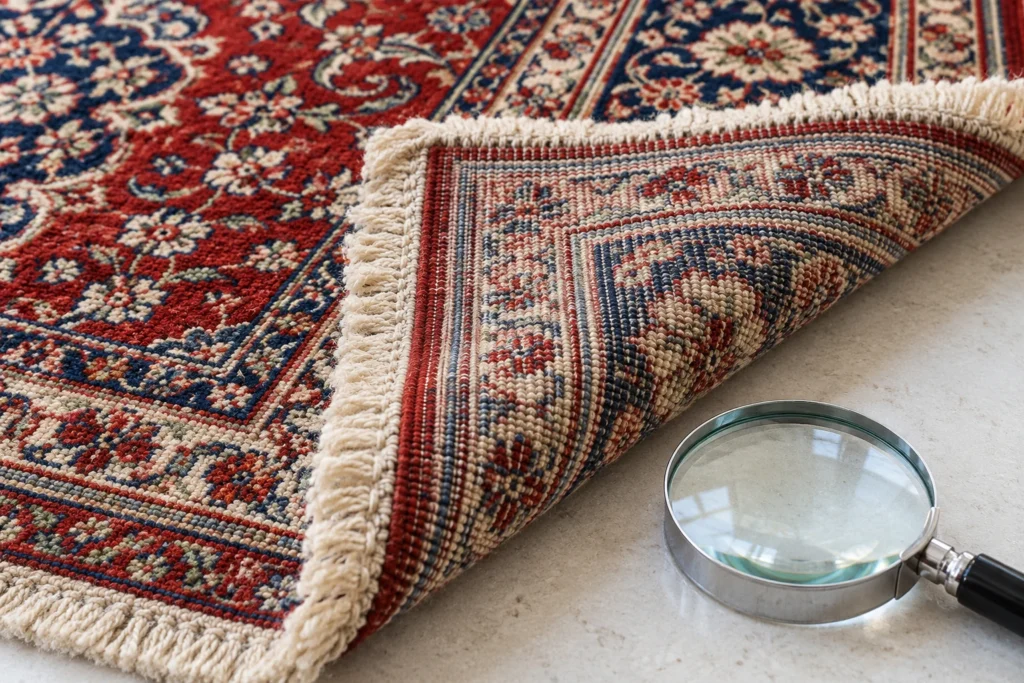
The question often appears years after the purchase. A rug has become part of a home, perhaps changed hands within a family, and someone wonders whether its description was accurate. Was it really Persian? Was the suggested age plausible? Did the price reflect craftsmanship and scarcity, or simply the enthusiasm of the moment?
A reputable dealer can be an important source of knowledge. The difficulty is that the market contains different grades of evidence. A label describing a rug as 'Kashan' may indicate a recognised design or trade category rather than a documented weaving location. 'Handmade' can be accurate without making a piece antique. Even a beautifully knotted rug may be relatively common. Good buying therefore begins with understanding what, precisely, is being represented.
Authentication is an exercise in weighing clues, not finding a magical certificate. A specialist may examine the structure from the back, the foundation materials, knotting, wool or silk, dyes, dimensions, design and signs of age. The Metropolitan Museum of Art notes that materials, weaving structure and dye characteristics can help establish where historical carpets were made. Individual clues can mislead; their consistency matters more than any one feature.
Provenance is different from attribution. Attribution asks what a piece probably is and where or when it may have been woven. Provenance concerns the documented chain of ownership. An old invoice, family photograph or auction catalogue can provide context, but it may not establish every historical claim. A confident appraisal should explain the degree of certainty rather than conceal it.
Price requires equal care. A dealer's retail asking price, an auction estimate and an insurance replacement figure serve different purposes. Condition, fashion, regional demand and the availability of comparable examples can affect what a willing buyer would actually pay. It is entirely possible to love a rug and have paid more than its current resale value. That does not automatically mean the purchase was unwise; enjoyment is part of its return.
Buyers should also read descriptions of restoration carefully. Repairs are common in older textiles, and sound conservation can be entirely appropriate. Yet extensive reweaving, chemical treatment, reduced dimensions or repainted areas may affect authenticity and buyer confidence. Christie’s specifically warns that excessive or poor-quality restoration can harm value.
Before buying, request clear photographs of the front and reverse, detailed condition information, dimensions, any known repair history and the seller's basis for attribution. For a substantial purchase, an independent opinion may be prudent. After purchase, retain the documentation even if the rug is never intended for resale.
Owners who inherit a piece should avoid the opposite mistake: assuming that an unlabelled rug has no significance. It may deserve a considered assessment before being altered or disposed of.
Even an inconclusive opinion has value when it prevents an unsupported label from becoming an accepted family fact.
H. Behnam's Persian rug expertise forms part of Oriental Rug Services Ltd's approach to examining important works. An informed assessment can clarify what is known, what remains uncertain and which aspects of the textile deserve particular protection.
Sources and further reading
Christie’s, Collecting Guide: Oriental Rugs and Carpets
The Metropolitan Museum of Art, Carpets from the Islamic World, 1600–1800